Lyman front · Donetsk region · Ukraine’s 3rd Army Corps
Operation Vivaldi
Between May and October 2026, Ukraine’s 3rd Army Corps cut off a russian salient north of Lyman in four stages, breaking the northern arm of a russian pincer aimed at encircling Ukrainian-held Donbas. The corps reports 277 km² regained; the independent DeepState map, which counts only changes in occupied territory, shows about 155 km².
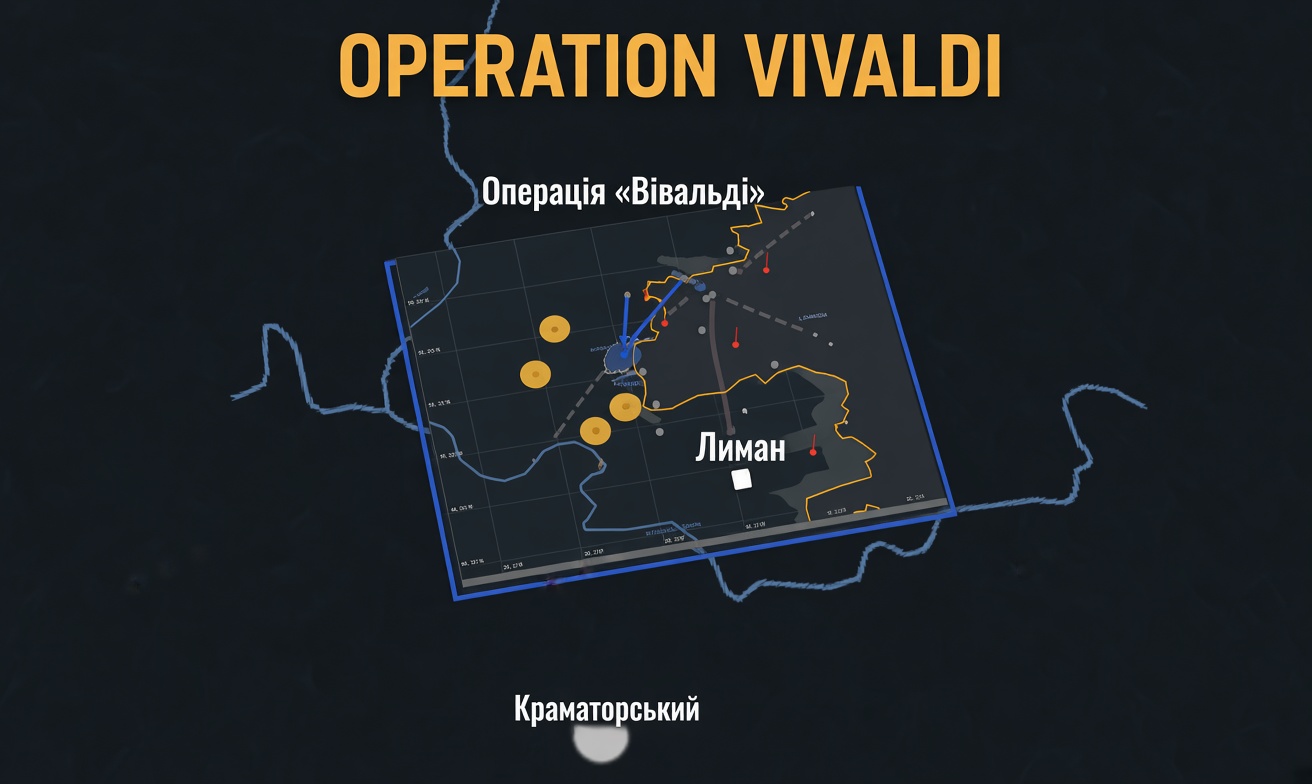
- regained — per the 3rd Army Corps
- 277 km²
- per DeepState — change in occupied area only
- ≈155 km²
- settlements, 9 of them liberated
- 16
- 22.05 → 14.10.2026, four stages
- 145 days
In brief
- A pincer brokenrussia’s northern push (Lyman → Sviatohirsk → Barvinkove) was stopped and the Kharkiv–Sloviansk highway held. Moscow pulled part of its 1st Guards Tank Army from Kupiansk to plug the gap.
- The blow fell elsewhererussia massed reserves near Shandryholove; the main strike went in at Nove.
- Almost four months of silenceThe first assault came on 22.05; the first public report only on 15.09, as stage 1 was ending.
- Machines ahead of infantryGround robots (UGVs), BTR-60 carriers turned into remote kamikaze vehicles, and electronic warfare that, by the corps’ count, foiled some 20,000 russian drone missions.
Phase by phase
Pick a phase — the map and the description change together
Turn your phone sideways for a bigger map.
- 1Behind the 20th Army’s lines: from Kolodiazi to the outskirts of Zarichne
- 2Approximate: Lypove → Zelena Dolyna
- 3Approximate: Zelena Dolyna → Kolodiazi
- 4russia moves part of the 1st Guards Tank Army from the Kupiansk front
- Ukrainian strike
- Approximate / ISW line
- russian moves
- Where russia expected the blow
- Liberated
- Cleared, control restored
- Front line and occupied area (DeepState)
- Front line in the previous phase
- Regained in this phase
- Status unknown
- Drag to rotate; scroll or pinch to zoom.
14.10.2026 · announced
Stage 4: Zelena Dolyna, Lypove, Kolodiazi
Zelena Dolyna, Lypove and Kolodiazi were liberated — another 101 km². Near Kolodiazi the advance reached the rear of the 20th Army towards Zarichne. To close the breach, russia’s “West” group of forces moved part of the 1st Guards Tank Army to Lyman from the Kupiansk front. On 15 October the “Tin” (“Shadow”) group of the 125th Heavy Mechanised Brigade destroyed a russian group infiltrating along a tree line near Zelena Dolyna. In total: 277 km² and 16 settlements.
- km² regained, cumulative (3rd Corps)
- 277
- settlements, cumulative
- 16
- enemy losses in the stage*
- ≈3,000
- prisoners in the stage
- —
- Ukrainian strike
- Approximate / ISW line
- russian moves
- Where russia expected the blow
- Liberated
- Cleared, control restored
- Front line and occupied area (DeepState)
- Front line in the previous phase
- Regained in this phase
- Status unknown
- Drag to rotate; scroll or pinch to zoom.
Enemy losses are the 3rd Army Corps’ figures and have not been independently verified. Ukrainian losses have not been made public.
Claimed vs measured
The corps also counts ground cleared of russian infiltrators; DeepState counts only the change in occupied territory within the map of the operation (≈44 × 34 km). The gap reflects different methods, not a contradiction.
3rd Army Corps, cumulativeDeepState, cumulative
16 settlements
liberatedcontrol restored, cleared
Stage 1 · 15.09.2026
- Serednie
- Novoselivka
- Oleksandrivka
- Yarova
- Korovii Yar
Stage 2 · 20.09.2026
- Shandryholove
- Derylove
- Drobysheve
Stage 3 · 28.09.2026
- Nove
- Ridkodub
- Katerynivka
- Karpivka
- Novomykhailivka
Stage 4 · 14.10.2026
- Zelena Dolyna
- Lypove
- Kolodiazi
Why it matters
Vivaldi broke the northern arm of a russian pincer aimed at encircling the part of Donbas Ukraine still holds (Lyman → Sviatohirsk → Barvinkove) and kept the Kharkiv–Sloviansk highway open. To plug the breach, russia moved part of its 1st Guards Tank Army from the Kupiansk front, after which pressure on Kupiansk-Vuzlovyi eased. Within the map of the operation, DeepState’s occupied area shrank from 487 to 332 km² — by about a third.
The operation was run by the 3rd Army Corps under Brig. Gen. Andrii Biletskyi, with the 3rd Separate Assault Brigade leading the main assaults. It was kept quiet for almost four months: the first strike came on 22 May, the first public report only on 15 September.
How the operation was built
- Deep strikes to 50 km, then 120 km Corps drones hit fuel, depots, command posts and drone operators. A fuel pipeline into occupied Luhansk region was stopped; rear units of russia’s 144th Motor Rifle Division pulled back to Voronezh region.
- Air superiority for its own drones An electronic-warfare system (“Protective Dome”, as NV calls it) foiled about 20,000 russian drone missions, by the corps’ count. Short of fuel, russian units lacked generators to run their own jammers.
- Information silence from May to 15 September The operation went unannounced for almost four months. Biletskyi gave the first public report when stage 1 was already ending.
- From clearing to offensive It began by eliminating russian infiltration and the 20th Army’s bridgehead on the Nitrius, then grew into an offensive.
- Machines ahead of the infantry Ground robots carried supplies and cleared mines; BTR-60s converted into kamikaze vehicles broke strongpoints. Assault groups approached through ravines and gullies while separate groups covered the flanks.
- Deception: the blow fell elsewhere russia took Shandryholove – Zelena Dolyna for the main axis and burned its reserves there in counter-attacks. The real strike was prepared at Nove, where the surrounding heights give the initiative on the bridgehead.
Forces on both sides
Ukraine’s Defence Forces
 3rd Army Corps Commanded the operation. Commander: Brig. Gen. Andrii Biletskyi; deputy: Maj. Maksym Zhorin.
 3rd Separate Assault Brigade The main assaults: Nove on 22.05 and in stage 3; mobile groups.
 60th Separate Mechanised Brigade Supported the 22.05 strike at Nove; part of the operation’s force.
 66th Separate Mechanised Brigade Supported the strike at Nove; its tank battalion’s UGVs and Darts strike drones.
 125th Separate Heavy Mechanised Brigade The “Tin” (“Shadow”) group: tree line near Zelena Dolyna, 15.10.
 3rd Border Guard Detachment, named after Yevhenii Pikus Restored full control over Ridkodub in stage 3.
 10th Mobile Border Guard Detachment “Dozor” Special forces, stage 3.
- Drone units and others 21st Separate Unmanned Systems Battalion “KRAKEN 1654”, K-2 Unmanned Systems Battalion, Special Operations Centre “A”, 3rd Separate Reconnaissance Battalion, 25th Separate Assault Battalion, tactical groups of the 8th Special Operations Regiment, National Guard’s “Lasar’s Group”, 96th Separate Support Battalion (UGVs). Their sectors were not disclosed.
russian forces
- 20th Guards Combined Arms Army Held the salient north of Lyman. According to unconfirmed reports (ISW, 16.09), its commander, Lt Gen Roman Yurchenko, was removed.
 144th Motor Rifle Division (20th Army) 488th and 254th Motor Rifle Regiments. Lyman and Borova fronts; rear units withdrawn to Voronezh region; the regiments are due to be rotated out before winter.
 3rd Motor Rifle Division (20th Army) 99th Self-Propelled Artillery Regiment and 217th (possibly 237th) Tank Regiment on the Lyman front — per Mashovets, ISW 16.09.
 25th Combined Arms Army Crossed the Zherebets near Torske and pushed into Lyman; operates east and south-east of the town.
- 1st Guards Tank Army (elements) Moved from the Kupiansk front to Lyman in October, after which pressure on Kupiansk-Vuzlovyi eased.
- “Rubikon” drone unit russia’s elite drone unit; operated on the Lyman–Borova front, withdrawn on 18.09 after losses (per NV).
- “West” group of forces Overall command in this sector.
About the map
Sources 24
Sources
- Euromaidan Press: the Lyman salient, the 22.05 strike at Nove
- Meduza: russian armies and axes of advance
- ISW, 15.09: stage 1, 144th MRD
- ISW, 16.09: Nitrius bridgehead, 3rd MRD
- ISW, 8.10: 488th and 254th MRR
- ISW, 14.10: 1st Guards Tank Army, summary
- NV: strikes on logistics and electronic warfare
- LB.ua: stage 2, assault-group tactics
- TSN: UGVs and three russian armies
- Telegraf: where the russians expected the blow
- Militarnyi: stage 3
- 5 Kanal: Nove, 250+ prisoners, “Dozor”
- Censor.NET: stage 4, forces involved
- Suspilne: 125th Brigade near Zelena Dolyna
- Texty: 277 km², 8,000 losses
- Euronews: ISW lines of advance
- Kyiv Independent: 66th Brigade, UGVs
- DeepState: front line at the date of each phase
- Wikimedia Commons: 3rd Separate Assault Brigade Insignia - Second Variant.png — emblem, CC BY-SA 4.0, Davomme
- Wikimedia Commons: 60th Mechanized Brigade (2026).svg — emblem, Public domain
- Wikimedia Commons: Sleeve patch of the 144th Guards Motor Rifle Division.svg — emblem, Public domain
- Wikimedia Commons: Sleeve patch of the 3rd Motorized Rifle Division.svg — emblem, Public domain
- Wikimedia Commons: Great emblem of the 25th Combined Arms Army.svg — emblem, Public domain
- Natural Earth: rivers — village coordinates: Wikipedia, Mapcarta (OSM)